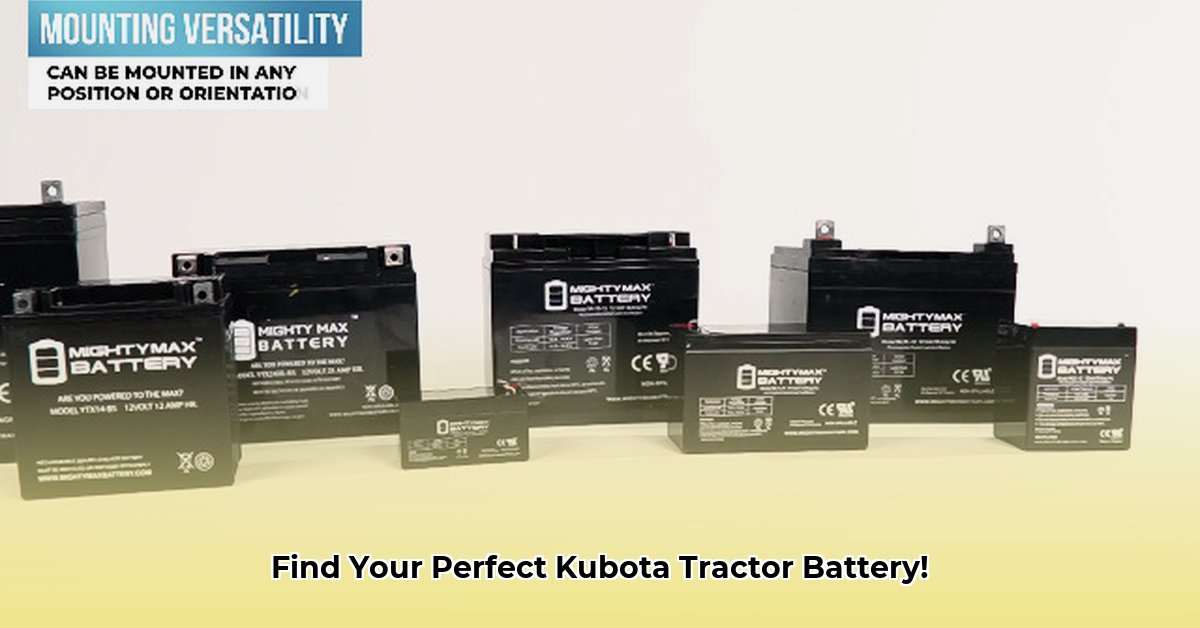
Finding the correct battery for your Kubota tractor is crucial for reliable operation. This guide simplifies the process, explaining the complexities of JIS and BCI battery standards and providing a step-by-step approach to selection and maintenance. For more information on Kubota tractor oil, check out this helpful resource: Kubota tractor oil guide.
Understanding Kubota Tractor Battery Sizing
Kubota tractors often utilize the Japanese Industrial Standard (JIS) battery sizing system, while many other regions use the Battery Council International (BCI) system. These systems aren't directly interchangeable, leading to confusion when replacing a battery. Incorrect battery selection can lead to poor performance, safety hazards, and even damage to your tractor. Therefore, precise identification is critical.
A Step-by-Step Guide to Choosing the Right Battery
Follow these steps to ensure you select the correct replacement battery for your Kubota:
Consult Your Owner's Manual: Your owner's manual provides the most accurate information regarding the correct JIS battery size for your specific Kubota model and year of manufacture. This is the primary source of truth for battery specifications.
Examine the Existing Battery (If Applicable): If replacing an existing battery, the JIS size is usually printed directly on it. This provides a quick verification method.
Utilize a Kubota Battery Size Chart: Many online resources and Kubota dealers offer model-specific charts that translate JIS sizes to approximate BCI equivalents. Note that these are approximations; always verify with the owner's manual. Why is this important? A poorly matched battery can lead to poor performance or even damage.
Measure Your Battery Tray: If uncertain, measure the dimensions of your tractor's battery tray. This guarantees a snug fit, preventing movement and potential short circuits.
Verify Terminal Placement: Ensure the positive (+) and negative (-) terminals on the replacement battery align perfectly with those on your tractor. Misaligned terminals are a serious safety risk and can cause damage.
Consider Cold Cranking Amps (CCA): The CCA rating indicates the battery's ability to start your tractor in cold weather. Higher CCA ratings are recommended for colder climates to ensure reliable cold-weather starts. What's the impact of low CCA? Difficulty starting your tractor, especially in cold conditions.
Check Reserve Capacity (RC): RC indicates how long the battery can power accessories after the engine is off. Higher RC is beneficial for tractors with numerous accessories. Does your Kubota have a winch or other heavy-draw accessories? Then a battery with higher RC is crucial.
Sample Kubota Tractor Battery Specifications
The following table provides example specifications; however, always consult your owner's manual for accurate data specific to your tractor model and year. This data is for illustrative purposes only.
| Kubota Model | JIS Group Size | Approximate BCI Group Size | CCA (at 0°F) | RC (minutes) | Notes |
|---|---|---|---|---|---|
| BX23S | 55B19 | Group 26 | 400 | 120 | Specifications vary by year and features. |
| L3901 | 65B24 | Group 31 | 600 | 180 | Always verify with your dealer or owner's manual |
| L47 | 65B24 | Group 31 | 650 | 190 | Consider higher CCA for cold climates. |
Maintaining Your Kubota Tractor Battery
Regular maintenance significantly extends your battery's lifespan:
Clean Battery Terminals: Regularly clean terminals with a wire brush to remove corrosion. A baking soda solution can further aid in cleaning.
Check Fluid Levels (If Applicable): For batteries with removable cells, check fluid levels monthly, adding distilled water as needed.
Prevent Deep Discharges: Avoid completely draining the battery. Regular use minimizes this, while a battery maintainer is vital for extended storage periods.
Secure Battery Mounting: Ensure the battery is firmly secured in the tray to prevent damage and potential hazards.
Troubleshooting Starting Issues
If your tractor fails to start, consider these factors:
Check Battery Connections: Ensure all terminals are securely connected, as loose connections are a common cause of starting problems, even with a fully charged battery.
Inspect Starter Motor: A faulty starter motor prevents the engine from cranking, and should be evaluated by a mechanic.
Verify Alternator Function: A malfunctioning alternator may not adequately recharge the battery. This also warrants professional diagnostics and repair.
By carefully following these steps and consulting your Kubota owner's manual, selecting and maintaining the correct battery for your tractor becomes straightforward. Why is this so important? A properly functioning battery ensures reliable operation, minimizing downtime and maximizing productivity.